
ENG: Day 4 - 20 March - OC-33 Advisory Opinion on Democracy
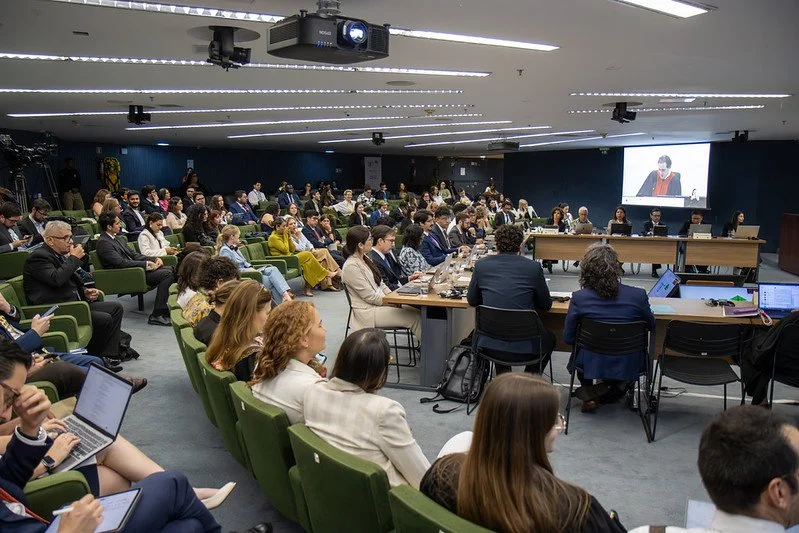
Foto por Ester Vargas, flickr CorteIDH
March 20th 2026 marked the fourth and final day of the public hearings taking place in Brasília before the Inter-American Court of Human Rights regarding an advisory opinion on Democracy and its protection under the Inter-American system of human rights protection – a request made by the State of Guatemala.
On this fourth day, the Court heard 32 oral statements from electoral and constitutional courts, non-governmental organisations (NGOs), academic institutions, law clinics, research centers, and individual submitters. After four long days, the delegation from the requesting State (Guatemala) brought to a close what has been the second most participatory consultative process in the Court’s history. The full list of interventions can be found here.
Without attempting to be comprehensive, below is a brief summary of the presented claims:
The central theme was the consolidation of democracy as a structural and normative concept in lieu of a political one. Constitutional and electoral courts presented democracy as crucial concerning the legitimacy of the constitutional order and as a prerequisite for the efficacy of all other rights. The Constitutional Court of Colombia framed it as essential, global, extensive and intersectoral, while the Constitutional Court of Peru refined the notion of democracy as a “container right” suggesting both its irreversible nature –once recognised– and the existence of a core set of minimum democratic standards which permit State institutional discretion.
The debate concerning whether democracy constitutes an autonomous right reached its most advanced stage. DeMetra and Pablo David Portillo claimed that recognition would enable the Court to respond to the structural decline of democracy, not solely isolated violation, and address "plurinoffensive" harms impacting individuals and the democratic collective. The Instituto Tecnológico de Monterrey and Consultorio Jurídico y Centro de Conciliación de la Universidad de Santander, holding opposing stances, affirmed democracy’s centrality, yet emphasised that formal recognition risks normative uncertainty, jurisdictional expansion and the politicisation of litigation. Instead, they argued for the reinforcement of democracy as a transversal principle by the interpretation of current Convention rights.
Electoral integrity and institutional independence came to be recognised as a central dimension of democracy. The Supreme Electoral Tribunal of Guatemala and the DPLF revealed how democratic erosion tends to rise through interference in electoral authorities, the criminalisation of electoral participants, and post-election manipulation. Their shared position remained that formal guarantees, including the right to vote, were insufficient without structural protections. DPLF and the Clínica de Acceso a la Justicia del ITESM claimed that independence guarantees traditionally linked to the judiciary– merit-based appointments, tenure, protection from interference– should extend to all electoral bodies, including administrative authorities in regards to their direct effect on political rights.
XUMEK and Clínica de Acceso a la Justicia del ITESM argued for democracy to necessitate effective, equal, and meaningful participation together with separation of powers, enforceable rights and the rule of law. Through critiquing “low-intensity democracy”, they underscored that systems confined to electoral participation were vulnerable to exclusion, declining trust and diminished legitimacy. They further placed emphasis on material equality, demanding the removal of structural barriers to participation and the incorporation of corrective measures, such as parity methods.
Pluralism and political parties were examined as institutional expressions of democracy, subject to legal constraints. It was claimed that while regulatory variation was granted by the Convention, States have a positive obligation in ensuring inclusive participation through political organisations. Nonetheless, any restrictions imposed must be non-discriminatory, proportionate and necessary in upkeep a democratic society. A fundamental tension analysis was whether democracy should permit anti-system actors. María Camila Ordoñez Sandoval and José David Velandia Pulido contended that current Inter-American standards already establish mechanisms to restraints where fundamental rights or democratic order is being undermined.
The role of representative institutions, specifically Parliament, was redetermined as central to democratic protection. PARLA emphasised that democratic erosion in the region hardly ever occurs through sudden collapse, but via progressive decline of representative bodies. Parliament was presented as completing representative, deliberative and oversight functions crucial to the stability of democracy, where citizenship was comprehended as demanding active and constant participation, extending beyond formal equality.
A core intervention in favour of recognising an autonomous human right to democracy was advanced by Ecab Amor Vázquez (NIKA). He conceptualised the right around a tripartite core: (i) a deliberative dimension anchored in public debates, (ii) a guarantee-oriented dimension anchored in the rule of law and judicial independence, and (iii) a dimension of legitimacy rooted in electoral integrity and equality. Furthermore, he developed its bidimensional character, parking an individual right to participate with a collective.institutional dimension, guaranteeing the orderly functioning of democratic frameworks, tied with a positive and negative dimension. Critically, he introduced an intergenerational aspect, claiming that by failing to protect democracy nowadays imposes structural burdens on future generations, presenting democratic protection as a present obligation, but also an owed duty across time.
Digital environments and disinformation were reframed as structural risks to democracy, now regarded as part of its institutional dimension, instead of an isolated challenge. XUMEK, DPLF, and CELE warned the court of threats linked to algorithmic manipulation, microtargeting, and unequal flows of information, advocating for the adoption of regulatory frameworks grounded in transparency, traceability, and data protection. Nonetheless, warnings were issued regarding over-regulation, as it may limit freedom of expression, strengthening the ongoing needs for balanced responses.
A frequent theme was the interdependence between the triad of democracy, rule of law, and human rights with the Supreme Court of Justice of Panama, Constitutional Court of Peru, and the Clínica de Acceso a la Justicia del ITESM continuously rejecting the prospect of isolating each element. Democracy was framed as both a prediction for and a product of rights protection: its deterioration causes structural impacts across the Convention framework as a whole.
Judges’ questions: The bench focused its line of questioning on the consequences, restraints and institutional implications of the presented claims. Judge Diego Moreno Rodríguez centered on the effects of recognising democracy as an autonomous right for the internal organisation of political parties, and the approach towards anti-democratic actors, while highlighting concerns regarding reduced citizen participation and the need for institutional design delivering effective results. emphasised the scope of proposals, questioning whether the court should integrate such detailed institutions prescriptions in the advisory opinion, placing a warning on the risk of shifting the Court into a policy-making body and politicisation. Judge Verónica Gómez questioned the way independence guarantees should apply to electoral authorities not exercising judicial functions. Judge Ricardo Pérez Manrique touched upon the regulation surrounding digital environments, questioning who should be in charge of detecting and moderating electoral misinformation. He then articulated concerns of corruption in electoral systems, specifically asking how to prevent individuals tied to corruption from assuming positions within oversight bodies.
After four days of intense public hearings, the second most participative process in the Court’s history came to a close. We are confident that our beloved Court will establish standards which live up to the troubling moment our region is going through.
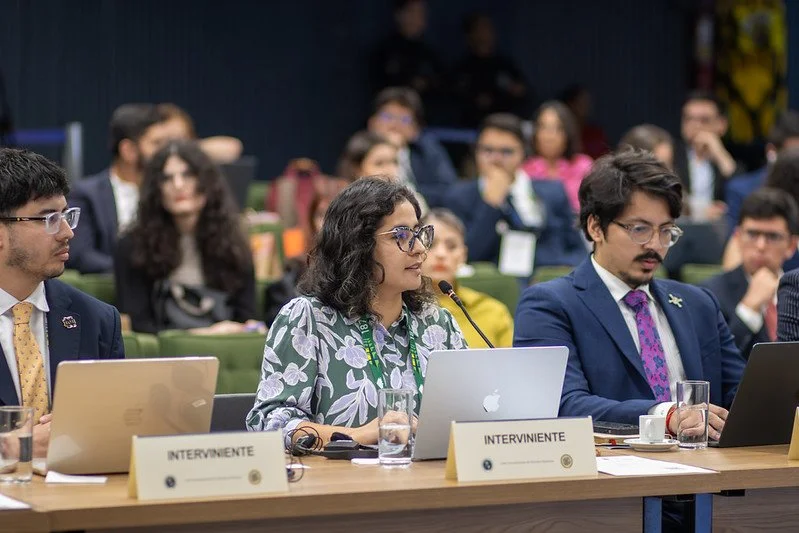
Foto por Ester Vargas, flickr CorteIDH
