
ENG: Day 1 - 17 March - OC-33 Advisory Opinion on Democracy
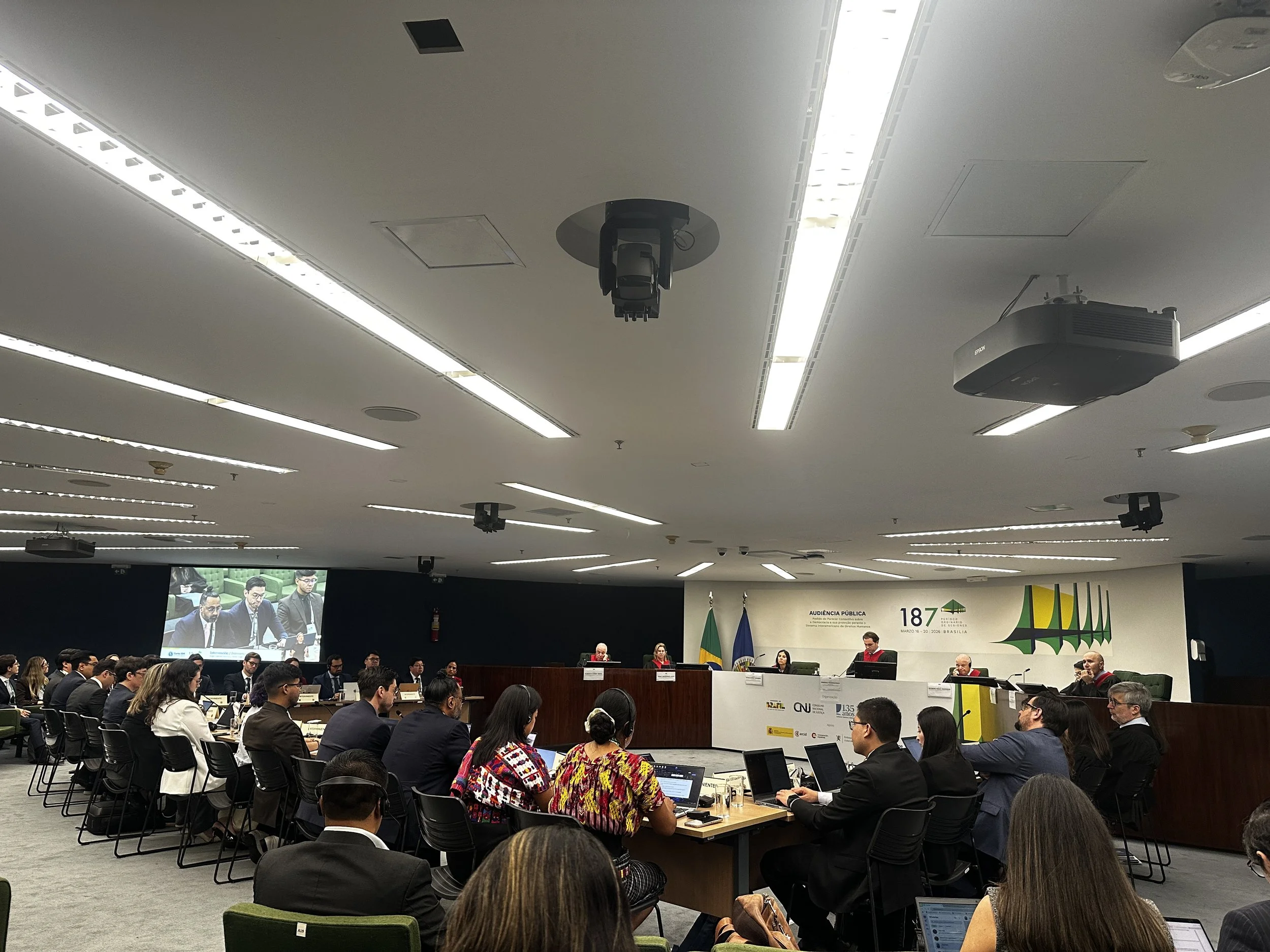
Yesterday, March 17th 2026, marked the first day of the public hearings taking place in Brasília before the Inter-American Court of Human Rights regarding an advisory opinion on Democracy and its protection under the Inter-American system of human rights protection – a request made by the State of Guatemala.
During this first day, a wide range of States and international organisations presented their oral arguments, including: Guatemala, Brazil, Colombia, USA, Mexico, Paraguay, Uruguay, the Inter-American Commission on Human Rights (CIDH), the Inter-American Commission of Women (ICM), and UN Women.
Here is a short recap of some of the arguments presented:
In an answer to what essentially forms the central question of these proceedings, several participants strongly argued in favour of recognising the autonomous human right to democracy under the American Convention on Human Rights, including Guatemala, Colombia, and the CIDH. They further postulated that the right had both an individual and collective dimension with Guatemala particularly highlighting the right’s’ inherent intergenerational dimension.
While arguing against an autonomous right to democracy, Mexico and Brazil posited that democracy must be understood as a structural or interpretative legal principle foundational to the American Convention on Human Rights.
The United States rejected the recognition of democracy as an autonomous right, advocating for a focus on existing protected rights (such as political participation, equality, and due process) and cautioning against imposing a uniform democratic model across the region.
Most interventions, including those by Guatemala, Colombia, Mexico, Brazil, Paraguay, Uruguay, and the CIDH, recognized democracy as a necessary precondition for the enjoyment and protection of all human rights.
Interventions by Brazil, the CIM, CIDH, and UN Women particularly highlighted that there is no full democracy without gender equality, stressing parity, political participation, and the need to address violence against women in political life.
Across interventions, there was broad agreement that democracy cannot be reduced to elections alone and that its content comprised a broad range of issues, such as, separation of powers, accountability, inclusion, access to justice, freedom of expression, access to information, due process, effective remedies, electoral systems, the right to defend rights, the right to truth, freedom of association, judicial independence, protection of marginalized and vulnerable communities, protection against digital threats, and many more.
The judges asked a series of insightful and difficult questions to the participants, particularly focusing on themes, such as the normative status and legal basis of the right to democracy, the justiciability and standing regarding the right, its individual and collective dimensions, reparations and remedies, the added value of recognising the right as an independent right, etc.
Follow NIKA on our socials to stay in the loop on the developments in the public hearings for AO-33.
