
ENG: Day 3 - 19 March - OC-33 Advisory Opinion on Democracy
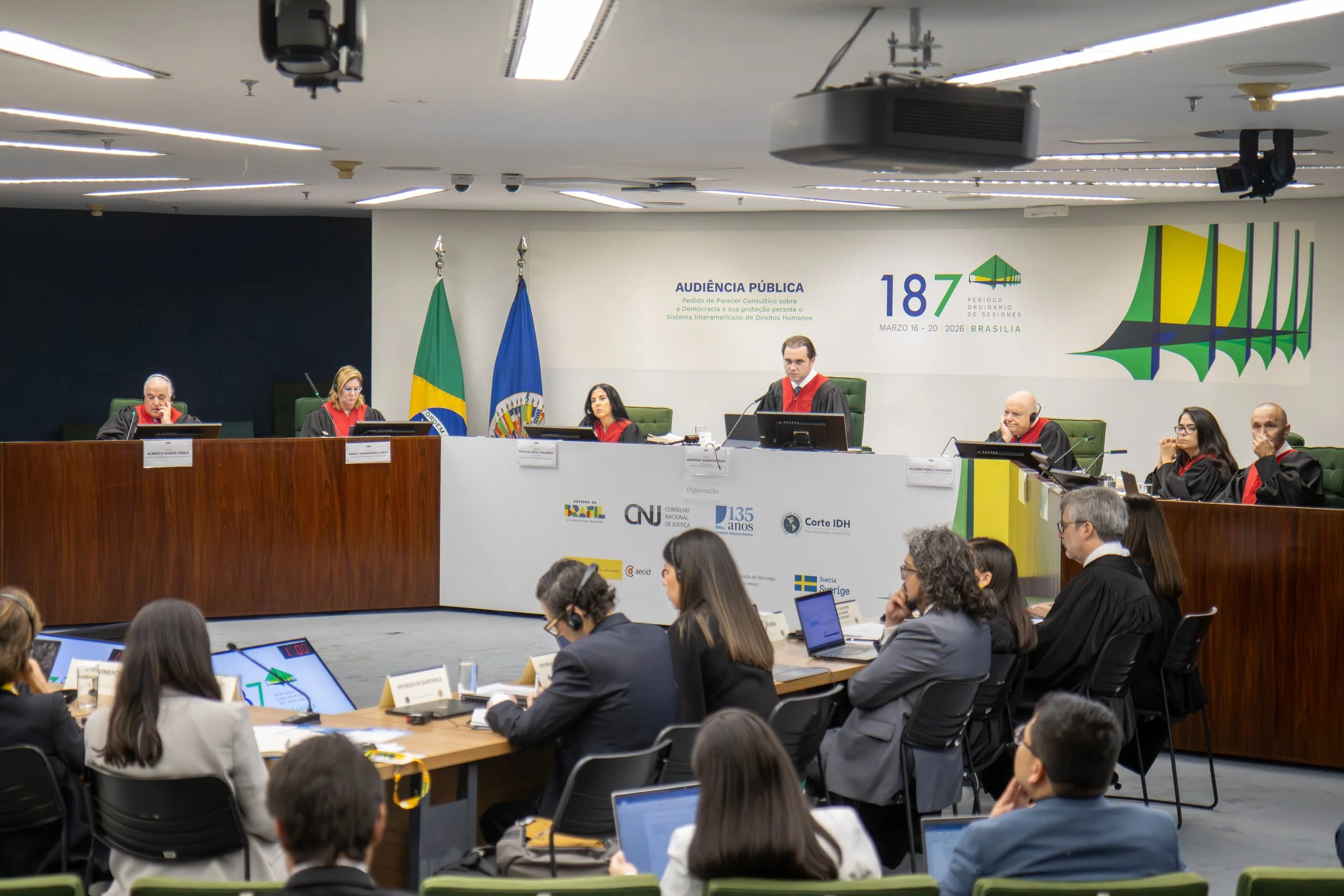
Foto por Ester Vargas, flickr CorteIDH
Yesterday, March 19th 2026, marked the third day of the public hearings taking place in Brasília before the Inter-American Court of Human Rights regarding an advisory opinion on Democracy and its protection under the Inter-American system of human rights protection – a request made by the State of Guatemala.
During this third day, a total of 42 oral statements were made before the Court by a wide range of actors, such as non-governmental organisations, academic institutions, research centers, law clinics, and individuals. The full list of interventions can be foundhere.
Without attempting to be comprehensive, below is a short recap of some of the arguments presented:
Democracy, once again, was framed as an autonomous right with individual, collective, and institutional dimensions, functioning simultaneously as a right in itself and as a precondition for the exercise of all other rights. Democratic erosion was characterised not as a violation of a single right but as producing multi-faceted effects across the entire system of Convention-protected rights. The Faculty of Law of the University of El Salvador contended that democracy, though not explicitly positivised in the ACHR, constitutes an implicit, structurally derived right whose enforceability activates when its breakdown compromises the effective enjoyment of Convention rights, and that recognition would not infringe upon State sovereignty but rather systematise an already existing jurisprudential heritage.
Several participants argued in favour of an enforceable and justiciable autonomous right to democracy. To that end, it was contended that individuals can access the Inter-American system when the violation of their rights occurs as a consequence of the breakdown of the democratic order. To that end, the proposed criteria for standing would include: (1) the existence of an affectation in the exercise of rights and (2) a differentiated exposure to institutional weakening, especially in contexts of serious democratic breakdown. The recognition of this right was essential for claims of measures of reparations and guarantees of non-repetition to be made.
Intersectionality and equality: There was strong consensus on the need to include historically marginalised groups (with a particular importance given to gender inequality, but also including indigenous peoples, tribes, communities and groups, afro-descendant communities, LGTBQI+ groups, adolescents, etc.), as part of the constitutive elements of democracy, rather than mere policy instruments, of democratic governance. Legal measures must be advanced in order to avoid a “tyranny of the majority” that destroys pluralism to ensure effective political participation of minority groups which lack recognition and protection. For instance, CEJIL and the GQUAL Campaign proposed parity as a permanent structural principle derived directly from the interpretation of the ACHR, advocating for a reinforced judicial standard of review. The Centro de Derechos Reproductivos advanced asserted democracy's dual role as a right and precondition, the gender perspective as a structural requirement, and reproductive autonomy as central to democratic participation, citing Artavia Murillo v. Costa Rica and Celia Ramos v. Peru. The importance of these measures was highlighted by Akãhatã, who emphasised the disproportionate consequences for women, girls, adolescents, and LGBTQI+ families of constitutional reforms that lack pluralistic deliberation.
Broad definition of democracy and international legal framework:There was also general consensus on the need for a “substantive democracy” beyond a merely procedural definition. The Universidad de Guadalajara argued that the ACHR, the ICCPR, and the OAS Charter together impose combined obligations on States to guarantee equal political rights, self-determination, freedom of expression, and peaceful assembly, defining democracy as a way of life founded on continuous economic, social, and political improvement rather than merely a legal structure or political regime.
Self-determination:Several participants established a direct link between democracy and the right to self-determination, characterising the latter not only as a geopolitical principle of independence but as a collective expression of human dignity on the political plane that materialises in democratic governance. It was argued that if democracy sustains self-determination, it cannot be of lesser normative status than the right it upholds, and that defending peoples' self-determination against hate speech and technological manipulation is defending the very language of humanity.
Judicial independence:The Libera Foundation and Observatory of Rights and Justice Ecuador argued that judicial independence is an essential component of the right to democracy, characterised the obligation for checks and balances, together with the protection of judges from criminalisation and organised-crime infiltration. The ITESO Jesuit University of Guadalajara reinforced this by referencing the Mexican judicial reform as an illustration of institutional weakening, contending that the Inter-American system protects the existence of effective checks and balances, functional independence, and suitable judicial remedies to prevent arbitrariness.
Education and the pro persona principle:Participants argued that compulsory human rights education at all levels constitutes an essential structural measure for the strengthening of democracy, and that the pro persona principle requires formal equality before the law to be treated as a starting point rather than a ceiling, triggering rigorous affirmative obligations on States to reverse structural discrimination.
Threats to democracy: Disinformation in digital contexts was identified as a structural threat to democracy, with participants warning that the proliferation of fake news through social-media platforms has undermined electoral integrity, weakened public trust, and endangered peaceful transitions of power. Algorithms operating without editorial control were said to exacerbate the dissemination of hate speech and transform misinformation into a political weapon; polarisation was described as eroding the capacity for dialogue and converting plurality into irreconcilable rivalry; and the role of artificial intelligence in amplifying anti-democratic narratives was specifically flagged. Participants urged the Court to clarify States' positive obligations to regulate digital platforms, establish electoral-monitoring mechanisms, and protect the informational environment as a dimension of the democratic order.
Judges' questions: The bench tested the boundaries and implications of the claims advanced, centring on three main lines: first, whether recognising democracy as an autonomous human right would demand a broader recharacterisation of international human rights law, to which CEJIL responded that the Inter-American system's advanced regulatory framework would permit a regional doctrine without universalising it; second, whether gender parity can be derived directly from the ACHR or depends on the prior recognition of a human right to democracy, with intervenors clarifying it can be grounded independently in the principles of equality and non-discrimination; and third, whether parity is a permanent structural principle or a corrective measure of temporary nature, with intervenors arguing for the former as the expression of substantive democratic equality, while judges pressed on practical design, intersectional accommodation, and the operationalisation of the proposed strict-scrutiny framework.
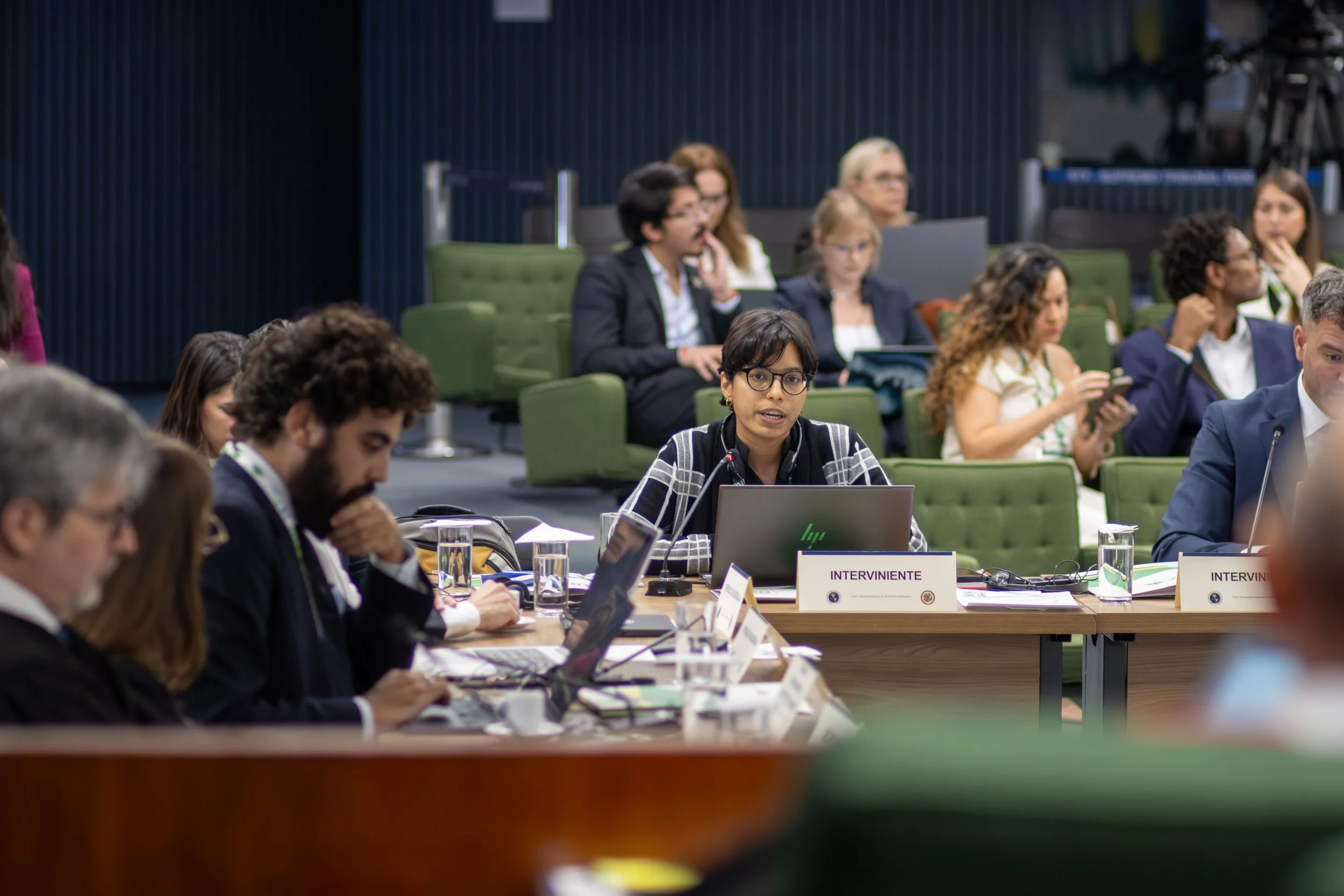
Foto por Ester Vargas, flickr CorteIDH
